📋 Table of Contents
- Why Mobile Number Verification Matters
- Benefit 1: Fraud Prevention & Scam Protection
- Benefit 2: Identity Verification for Businesses
- Benefit 3: Financial Security & Mobile Banking
- Benefit 4: Personal Safety & Harassment Prevention
- Benefit 5: Legal Compliance & KYC
- Benefit 6: Employment & Background Verification
- Benefit 7: Community Trust & Marketplace Safety
- How to Verify Mobile Numbers in Pakistan
- Frequently Asked Questions
Why Mobile Number Verification Matters in Pakistan
Pakistan has over 190 million active mobile subscribers, making it one of the largest mobile markets in Asia. As mobile phones have become the primary interface for banking, commerce, communication, and government services, mobile number verification has evolved from a niche security practice into an essential life skill. The stakes are higher than ever: Pakistani citizens lose billions of rupees annually to mobile phone scams, and countless individuals suffer harassment, impersonation, and identity theft through their mobile numbers.
Mobile number verification in Pakistan is uniquely powerful because of the country's comprehensive SIM registration system. Unlike in countries where phone numbers can be anonymous, every Pakistani mobile number is legally required to be registered against a verified CNIC. This means that when you verify a mobile number, you are accessing information tied to a real, legally identified person — making the verification far more meaningful and actionable than in less regulated markets.
Whether you are an individual trying to identify an unknown caller, a business owner verifying a customer's identity, or a hiring manager conducting background checks, mobile number verification provides a fast, accessible, and reliable method to establish trust and make informed decisions. Platforms like SimOwner put this capability directly in your hands. Let's explore the seven key benefits in detail.
Fraud Prevention & Scam Protection
The most immediate and universally relevant benefit of mobile number verification is protection against the ever-growing wave of telephone scams plaguing Pakistan. From fake bank calls claiming your account has been compromised, to fraudsters impersonating NADRA officials demanding your CNIC for "verification," Pakistan's phone scam ecosystem is sophisticated, organized, and devastatingly effective.
Mobile number verification allows you to instantly check the registered owner of a suspicious number before engaging or responding. If you receive a call from someone claiming to be a bank representative from 0300-XXXXXXX and verification shows the number is registered to a private individual in an unexpected location, this is a clear red flag. This simple check takes seconds but can save you from losing thousands — or even hundreds of thousands — of rupees to fraudsters.
In 2025 alone, FIA's Cybercrime Wing received over 50,000 complaints related to phone scams in Pakistan. Verification could have prevented the vast majority of these incidents. By building the habit of verifying unknown numbers before taking any financial or personal action, Pakistani citizens can significantly reduce their fraud exposure. Use our SIM number search tool to instantly verify any suspicious number.
Identity Verification for Businesses
For businesses operating in Pakistan, mobile number verification is an invaluable tool for Know Your Customer (KYC) compliance and customer identity assurance. Before extending credit, delivering goods, or providing services, businesses need confidence that the person they are dealing with is who they claim to be. Mobile number verification provides a quick, low-friction first layer of identity validation.
Consider an e-commerce business: a customer places a large order for cash-on-delivery using a mobile number. Before dispatching goods worth tens of thousands of rupees, verifying that the phone number matches the customer's stated identity takes seconds and could prevent costly returns or non-payment fraud. Similarly, a property rental agency can verify a prospective tenant's mobile number against their stated CNIC to confirm identity consistency before signing a lease.
Financial institutions, lending platforms, and microfinance organizations in Pakistan routinely integrate mobile number verification into their onboarding workflows. When a loan applicant provides a mobile number, the lending company verifies that the number is registered against the same CNIC provided on the application. A mismatch is a significant fraud indicator that warrants further investigation before proceeding. Our SIM Information tool provides the API-accessible data that businesses need for these workflows.
Financial Security & Mobile Banking Protection
Pakistan's mobile financial services sector — led by JazzCash, EasyPaisa, and a growing number of digital banks — processes billions of rupees in transactions daily. The security of these transactions depends critically on the assumption that the mobile number receiving or authorizing a transaction is controlled by its legitimate registered owner. When this assumption breaks down — for example, through SIM swapping fraud — financial losses can be catastrophic.
SIM swap fraud occurs when a fraudster convinces a telecom operator's customer service (through social engineering or bribery) to transfer a victim's number to a new SIM card controlled by the attacker. Once they control the victim's number, they can receive OTPs (one-time passwords) intended for banking authentication and drain the victim's accounts. Mobile number verification helps detect SIM swap attacks: if a number suddenly appears registered to a different person than expected, it may indicate a recent fraudulent SIM swap.
Banks and fintech companies can use periodic mobile number verification checks to detect changes in SIM registration details for their customers' linked numbers — a change in registered owner name or network operator could signal a SIM swap and trigger additional security verification before processing any transactions. Individual users can protect themselves by regularly using CNIC SIM Check to confirm their own numbers remain registered correctly.
Personal Safety & Harassment Prevention
Harassment via mobile phone — including threatening calls, abusive messages, and unwanted contact — is a serious issue affecting millions of Pakistanis, particularly women. Mobile number verification provides victims and concerned parties with the ability to identify unknown harassers, which is often a critical first step in building a legal case or seeking police assistance.
When harassment occurs, having the registered name and network associated with the harassing number can mean the difference between a complaint that goes nowhere and one that police can act on swiftly. Pakistan's PECA 2016 specifically criminalizes online and mobile harassment, with penalties including imprisonment. Verifying the harassing number through tools like SimOwner Details and documenting the registered owner information creates a crucial evidential foundation for legal action.
Beyond active harassment, many Pakistanis use mobile number verification proactively — for example, verifying the numbers of new contacts from online platforms, marketplace sellers, or people met at networking events — to establish a basic level of identity assurance before sharing personal information or meeting in person. This is particularly valuable in Pakistan's growing online dating and social media landscape where anonymous interactions carry inherent risks.
Legal Compliance & KYC Requirements
Pakistan's regulatory environment increasingly mandates identity verification for a wide range of business activities. The State Bank of Pakistan (SBP) requires financial institutions to maintain robust KYC processes. The Securities and Exchange Commission of Pakistan (SECP) has similar requirements for investment platforms. For these regulated entities, mobile number verification forms an important component of their compliance toolkit.
Under SBP's regulations for Branchless Banking (BB) accounts — which include mobile wallets like JazzCash and EasyPaisa — operators must verify that the mobile number linked to an account matches the CNIC used to open the account. This is not optional; it is a regulatory requirement. Failure to maintain these verification standards can result in significant penalties, license revocation, or regulatory action against the financial institution.
Beyond financial regulation, the National Anti-Money Laundering Committee (NAMLC) and Financial Monitoring Unit (FMU) have issued guidance that considers mobile number verification as part of customer due diligence processes for high-risk transactions. Businesses operating in sectors like real estate, jewelry, and large-value retail can use mobile verification as part of a broader AML (Anti-Money Laundering) compliance framework. Visit our Pak SIM Data guide to understand what data is available for compliance purposes.
Employment & Background Verification
Human resources professionals and hiring managers across Pakistan are increasingly using mobile number verification as part of pre-employment background checks. When a job applicant provides a mobile number on their CV or application, verifying that the number is registered against their stated CNIC provides a quick consistency check that complements traditional reference verification.
For roles involving access to sensitive information, financial resources, or vulnerable populations — such as bank employees, domestic workers, drivers, and healthcare staff — the ability to independently verify a candidate's mobile identity adds an important layer of security to the hiring process. Even a basic verification that the applicant's phone number is registered in their stated name and city can surface discrepancies that warrant further investigation.
Staffing agencies, gig economy platforms, and freelance marketplaces operating in Pakistan have adopted mobile verification as a standard trust signal. Platforms like food delivery services and ride-hailing apps use SIM verification to maintain accountability among their service providers, ensuring that the person behind each registered profile can be definitively identified if issues arise. This makes the entire platform safer and more trustworthy for all users.
Community Trust & Marketplace Safety
Pakistan's booming online marketplace ecosystem — from OLX to Facebook Marketplace and countless WhatsApp-based buying/selling groups — operates largely on trust between strangers. Mobile number verification has emerged as a powerful trust-building mechanism in these environments. When a seller or buyer provides a verified mobile number, the other party can confirm basic identity details, significantly reducing the risk of fraudulent transactions.
Consider a buyer interested in purchasing a used motorcycle listed online for PKR 150,000. Before transferring any advance payment or meeting the seller in an unfamiliar location, verifying the seller's mobile number through a service like SimOwner's search tool establishes the seller's registered identity. If the listed number is not registered in the seller's stated name or region, this is a strong fraud signal that could save the buyer from significant financial loss.
Community-level applications of mobile verification extend to neighborhood watch groups, school parent networks, and local volunteer organizations — all contexts where knowing who you are communicating with creates a foundation of trust. As Pakistan's digital participation continues to grow, mobile number verification will become an increasingly standard part of navigating both commercial and community interactions safely. Explore more articles on mobile safety on our SimOwner blog.
How to Verify Mobile Numbers in Pakistan
Now that you understand the seven key benefits of mobile number verification, here is a quick guide to the verification methods available to you in Pakistan:
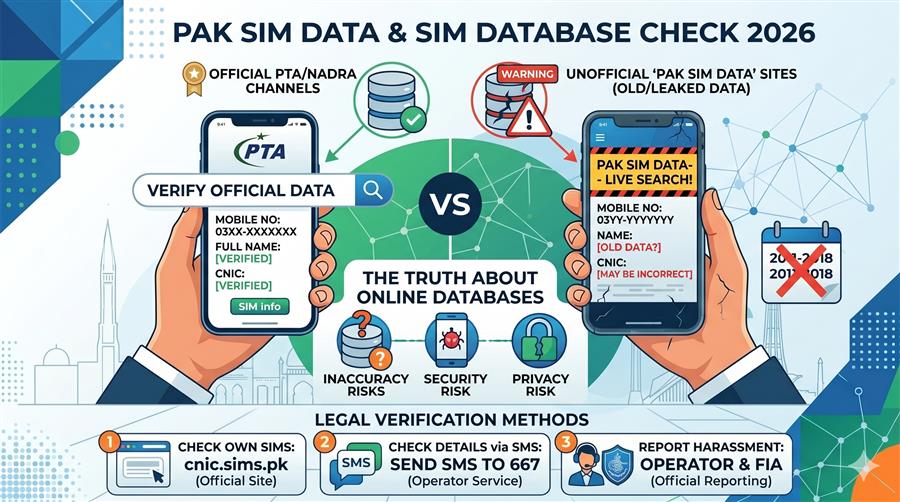
Visit SimOwner's search tool and enter any Pakistani mobile number to instantly retrieve the registered owner's name, network, and registration status. Fast, free, and available 24/7.
Send your own CNIC to 668 to check all SIMs registered under your identity. Ideal for personal security audits. Official PTA service, free of charge.
Contact the network operator's customer care (Jazz: 789, Telenor: 345, Zong: 310, Ufone: 333) for network-specific verification assistance.
Log in to mypta.gov.pk to access detailed SIM registration information for your CNIC, including activation dates and operator details.
Frequently Asked Questions
Is mobile number verification legal in Pakistan?
Yes, accessing SIM registration information for legitimate security, verification, and fraud prevention purposes is legal in Pakistan. The data is maintained in publicly accessible databases per PTA regulations. However, using this information to harass, stalk, or harm individuals is illegal under PECA 2016 and other applicable laws.
How accurate is mobile number verification in Pakistan?
Given Pakistan's mandatory biometric SIM registration system, mobile number verification is highly accurate. Every SIM is linked to a verified CNIC through NADRA's database. However, verification shows the registered owner — the person who signed up for the SIM — which may differ from the person currently using it if the SIM was gifted or sold informally.
Can businesses integrate mobile verification into their systems?
Yes, many telecom operators and data providers in Pakistan offer API access to SIM verification data for businesses with legitimate KYC and compliance needs. These integrations allow businesses to perform automated verification during customer onboarding. Contact your telecom operator or a licensed data service provider for API access details.
What should I do if someone is harassing me from an unknown number?
First, verify the number using our SIM owner lookup tool to establish the registered identity. Then block the number on your device. If harassment continues or involves threats, file a complaint with FIA's Cybercrime Wing (cybercrime.gov.pk) providing the number, nature of harassment, and any documented evidence.
Does mobile verification show the current user or the registered owner?
Mobile number verification in Pakistan shows the registered owner — the person against whose CNIC the SIM was issued via biometric verification. This may be the same as the current user, or it may be a family member or original purchaser if the SIM was informally transferred without a formal ownership change.
How can mobile verification protect me from SIM swap fraud?
By regularly verifying that your own mobile numbers remain registered in your name, you can detect unauthorized SIM swaps quickly. If a verification check suddenly shows a different name or unknown registration details for your own number, contact your telecom operator's fraud department immediately and alert your bank to freeze OTP-based authentication until the SIM is restored.
Start Verifying Mobile Numbers Today
Protect yourself, your business, and your loved ones with instant SIM owner verification. Free, fast, and reliable.